


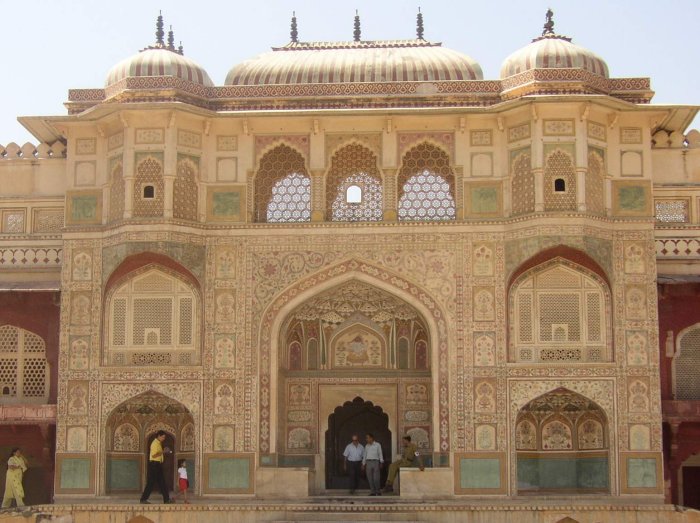
Area : Jaipur City (Municipal limits 64.75 sq. km. ,Pink City 9.8 sq. km.)
Population : 2,324,319
Altitude : 431 meters
Climate : Mean Max. Mean Min.
Summer : 45.0 degree C 25.8 degree C
Winter : 22.0 degree C 8.3 degree C
Best Season : September- March
Clothing : Summer light tropical
Winter: light woolen
Languages : English, Hindi, Rajasthani.
STD code : 0141
Jaipur (Hindi: जयपुर), also popularly known as the Pink City, historically sometimes rendered as Jeypore, is the capital of Rajasthan state, India. Jaipur is also the capital of Jaipur District. Jaipur is the former capital of a princely state of the same name. The city was founded in 1728 by Maharaja Sawai Jai Singh, the ruler of Amber. The population in 2003 was approximately 2.7 million.
The city was built of pink stucco in imitation of sandstone, and is remarkable among pre-modern Indian cities for the width and regularity of its streets. The city is laid out into six quarters, separated by broad streets 111 ft (34 m) wide. The urban quarters are further divided by networks of gridded streets. Five quarters wrap around the east, south, and west sides of a central palace quarter, with a sixth quarter immediately to the east. The Palace quarter encloses a sprawling palace complex (the Hawa Mahal, or palace of winds), formal gardens, and a small lake. A fort crowns the hill in the northwest corner of the old city. Another noteworthy building is Jai Singh's observatory, Jantar Mantar. Jaipur, with its rich and colourful past, resplendent with tales of valour and bravery is now one of the most important heritage cities in India, and is a must-see for tourists coming to India.
Jaipur is considered by many urbanists to be one of the best planned cities. In the 19th century the city grew rapidly and became prosperous, with a population of 160,000 in 1900, and the city's wide boulevards were paved and lit with gas. Its chief industries were in metals and marble, which are fostered by a school of art, founded in 1868. There was also a wealthy and enterprising community of native bankers. The city had three colleges and several hospitals.
The city was built of pink stucco in imitation of sandstone, and is remarkable among pre-modern Indian cities for the width and regularity of its streets. The city is laid out into six quarters, separated by broad streets 111 ft (34 m) wide. The urban quarters are further divided by networks of gridded streets. Five quarters wrap around the east, south, and west sides of a central palace quarter, with a sixth quarter immediately to the east. The Palace quarter encloses a sprawling palace complex (the Hawa Mahal, or palace of winds), formal gardens, and a small lake. A fort crowns the hill in the northwest corner of the old city. Another noteworthy building is Jai Singh's observatory, Jantar Mantar. Jaipur, with its rich and colourful past, resplendent with tales of valour and bravery is now one of the most important heritage cities in India, and is a must-see for tourists coming to India.
Jaipur is considered by many urbanists to be one of the best planned cities. In the 19th century the city grew rapidly and became prosperous, with a population of 160,000 in 1900, and the city's wide boulevards were paved and lit with gas. Its chief industries were in metals and marble, which are fostered by a school of art, founded in 1868. There was also a wealthy and enterprising community of native bankers. The city had three colleges and several hospitals.
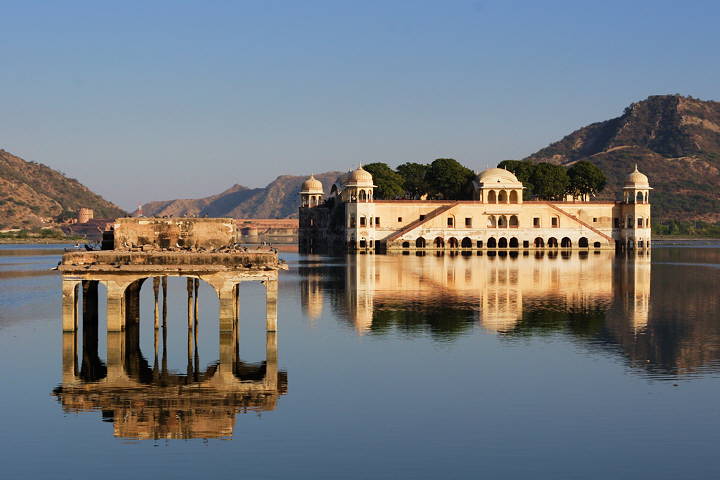
Jaipur Lake

The palace was built by Madho Singh in the 18th century. The palace looks best when the lake is full and you can catch a reflection in the water


1 comments:
The hospitality was great. Staff of the hotel is courteous and service provided by them is good. The buffet was very sumptuous. Hotel Jaipur Palace relieves the romance and glory of the Rajputana colorful past. Good and reasonable hotel to stay at. Centrally located .Considering overall standard of the hotel room tarrif is reasonable.
Post a Comment